
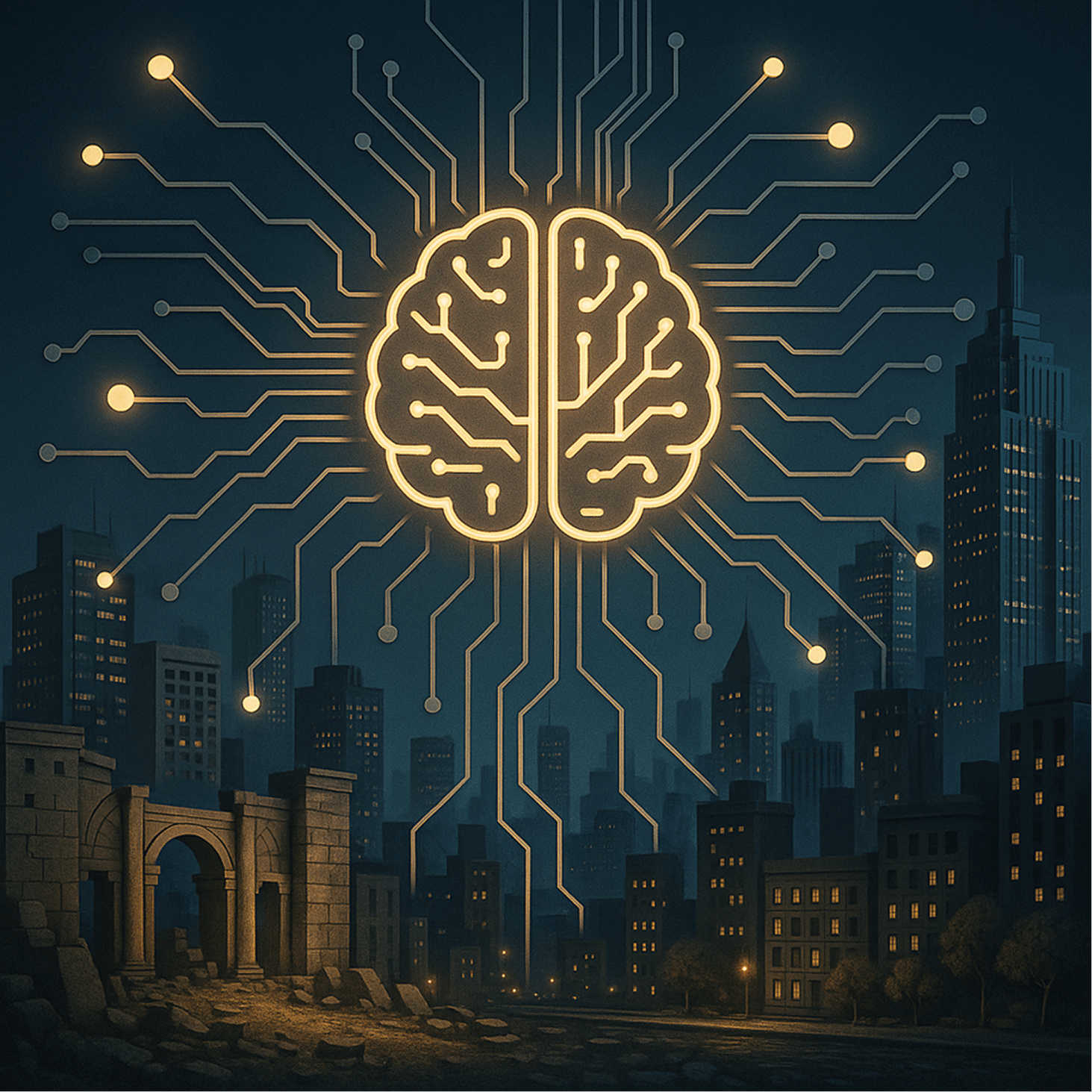
Artificial intelligence is often imagined as the mind of the modern city — analytical, omniscient, dispassionate. But the metaphor is incomplete. A city does not need a brain that dictates; it needs a nervous system that senses, connects, and adapts.
The Veridian Urban Index (VUI) embodies this shift. It integrates AI not as a distant observer, but as the living circuitry of urban vitality — a network that feels change, translates complexity, and coordinates renewal.
Most urban technologies reduce intelligence to computation: how fast traffic flows, how efficiently energy is consumed. The Veridian model expands cognition to include empathy and ethics. Its AI learns patterns not only in movement and consumption, but in emotion, trust, and civic dialogue.
By synthesizing data from sensors, satellites, institutions, and communities, the VUI constructs a multidimensional portrait of urban life — one that acknowledges the subjective as part of the measurable. The city becomes a sentient ecosystem, aware of its own rhythms and capable of self-adjustment.
Intelligence without integrity is surveillance. The Veridian system avoids that trap through embedded ethics. Each data layer includes provenance, consent, and contextual weight. Algorithms are transparent and explainable, ensuring that every output is accountable to human judgment.
This ethical architecture transforms AI from a tool of control into a partner of stewardship. It reinforces the principle that the city’s digital nervous system exists to serve its citizens — not to monitor them.
Through AI-enabled feedback loops, Veridian detects the early signals of imbalance: rising social tension, ecological stress, declining trust. Instead of responding after crisis, it anticipates and advises. When air quality dips, the system correlates it with hospital visits and traffic data. When civic engagement wanes, it traces correlations with unemployment or housing instability.
This sensory capacity allows cities to move from reactive governance to preventive regeneration — managing not just symptoms but sources.
No city exists in isolation. The Veridian platform’s distributed intelligence allows cities across the globe to learn from one another — Lagos from Tokyo, Addis Ababa from São Paulo, Vancouver from Nairobi. The system does not copy models; it translates patterns of resilience.
A heat-adaptation strategy in one region might inform flood management in another; a digital literacy campaign in one city could inspire trust restoration elsewhere. This cross-pollination creates a planetary nervous system — decentralized, ethical, and continuously self-improving.
The final test of intelligence is moral: does it deepen our humanity? Veridian’s answer is yes, if guided wisely. Its AI does not aspire to replace governance; it aspires to rehumanize it — by returning time, insight, and empathy to decision-makers.
In the regenerative city, AI becomes the medium through which wisdom circulates — not an algorithmic overlord, but a connective tissue linking conscience with action. It turns the noise of data into the music of understanding.
The Veridian Urban Index thus envisions a future where intelligence is not mechanical, but moral; not centralized, but shared; not cold, but alive. The city, finally, becomes what it was meant to be: a living intelligence — human at its core, regenerative by design, and wise enough to learn from its own pulse.