For more than a century, progress has been measured by expansion — GDP, construction cranes, population curves, consumption graphs forever pointing upward. Yet cities across the planet now stand as monuments to the exhaustion of that logic: smog-choked skylines, hollowed downtowns, displaced communities, and ecological debt that no budget can repay. Growth has reached its limit because it mistook quantity for vitality.
The Veridian Urban Index (VUI) reframes the very premise of prosperity. It argues that cities must graduate from growth economics to regenerative economies — systems that repair what they use, restore what they touch, and circulate value instead of extracting it. In this new calculus, the city’s health is measured not by how much it produces, but by how much life it sustains.
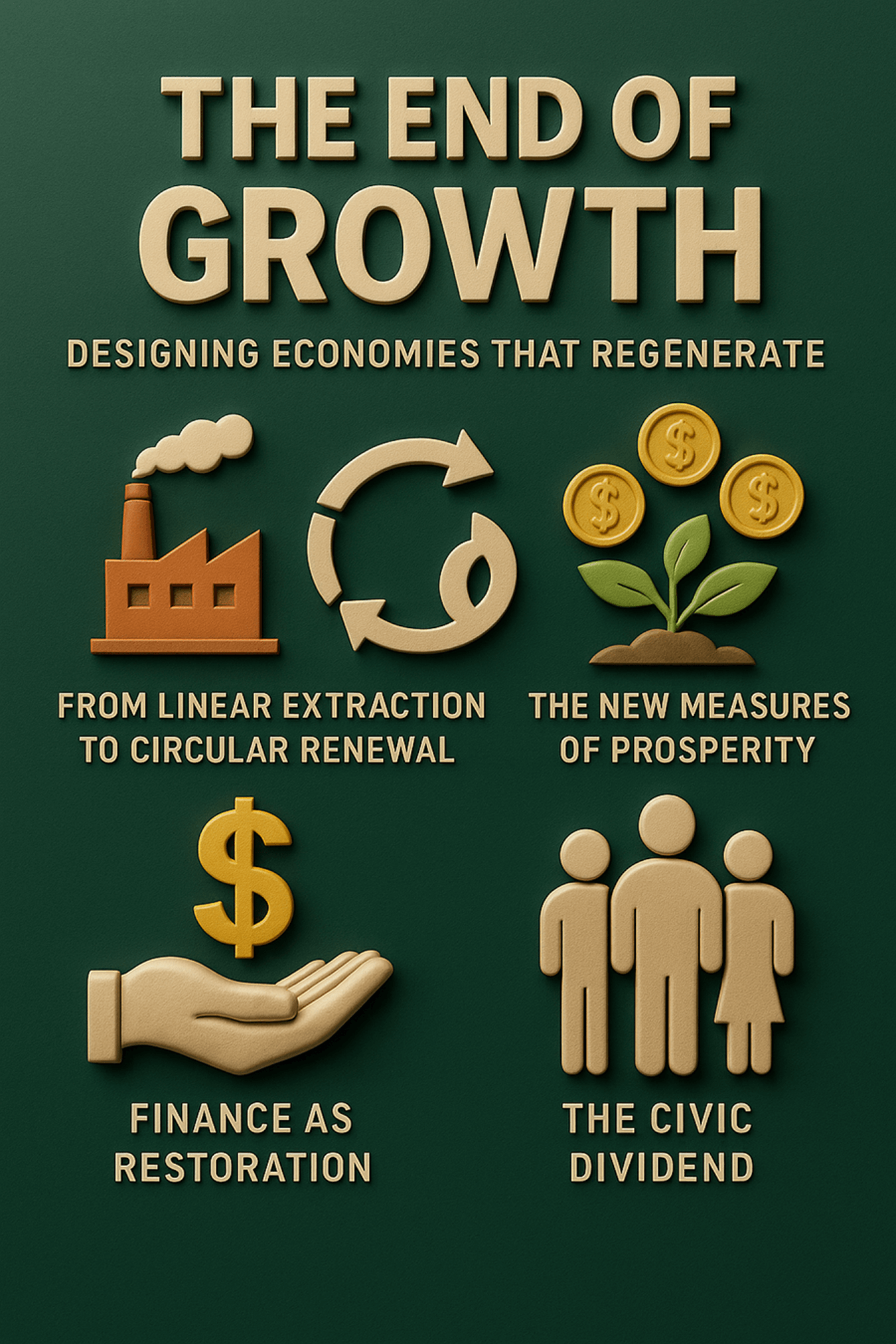
Traditional economics moves in straight lines: take, make, discard. The Veridian logic is circular: harvest, transform, reintegrate. Energy loops, material loops, knowledge loops — all governed by feedback rather than depletion.
A Veridian city redesigns its metabolism. Construction waste becomes raw input; wastewater becomes resource; data becomes shared insight. This shift is not aesthetic — it is structural. The VUI’s economic and ecological pillars track how effectively a city internalizes regeneration: whether procurement favors local materials, whether public budgets reward restoration, whether employment policy creates dignity instead of disposability.
GDP hides decay as long as it counts rebuilding after disaster as progress. The VUI substitutes indicators that tell the truth. It measures ecological recovery rates, energy reciprocity, public trust, and social equity — metrics that reveal whether prosperity multiplies or cannibalizes itself.
A regenerative economy asks different questions:
By embedding these inquiries in its AI logic, the Veridian platform transforms economics into ethics expressed in numbers.
Regeneration demands a moral reinvention of finance. The Veridian framework encourages cities to treat capital as a restorative instrument: issuing green bonds tied to ecological outcomes, structuring social-impact funds around civic trust, and redirecting subsidies from extraction to repair.
Here, profit becomes proof of alignment with planetary limits, not defiance of them. Investors gain returns proportional to the resilience they build, not the resources they drain.
In a regenerative economy, wealth circulates as well-being. The civic dividend replaces the shareholder dividend: cleaner air, equitable transport, restored wetlands, shared cultural spaces. The city’s balance sheet extends to future generations, measuring legacy instead of quarterly yield.
The Veridian Urban Index provides the blueprint for this post-growth paradigm — one where cities no longer compete for scale, but collaborate for sustainability; where progress is written not in GDP but in generational continuity.