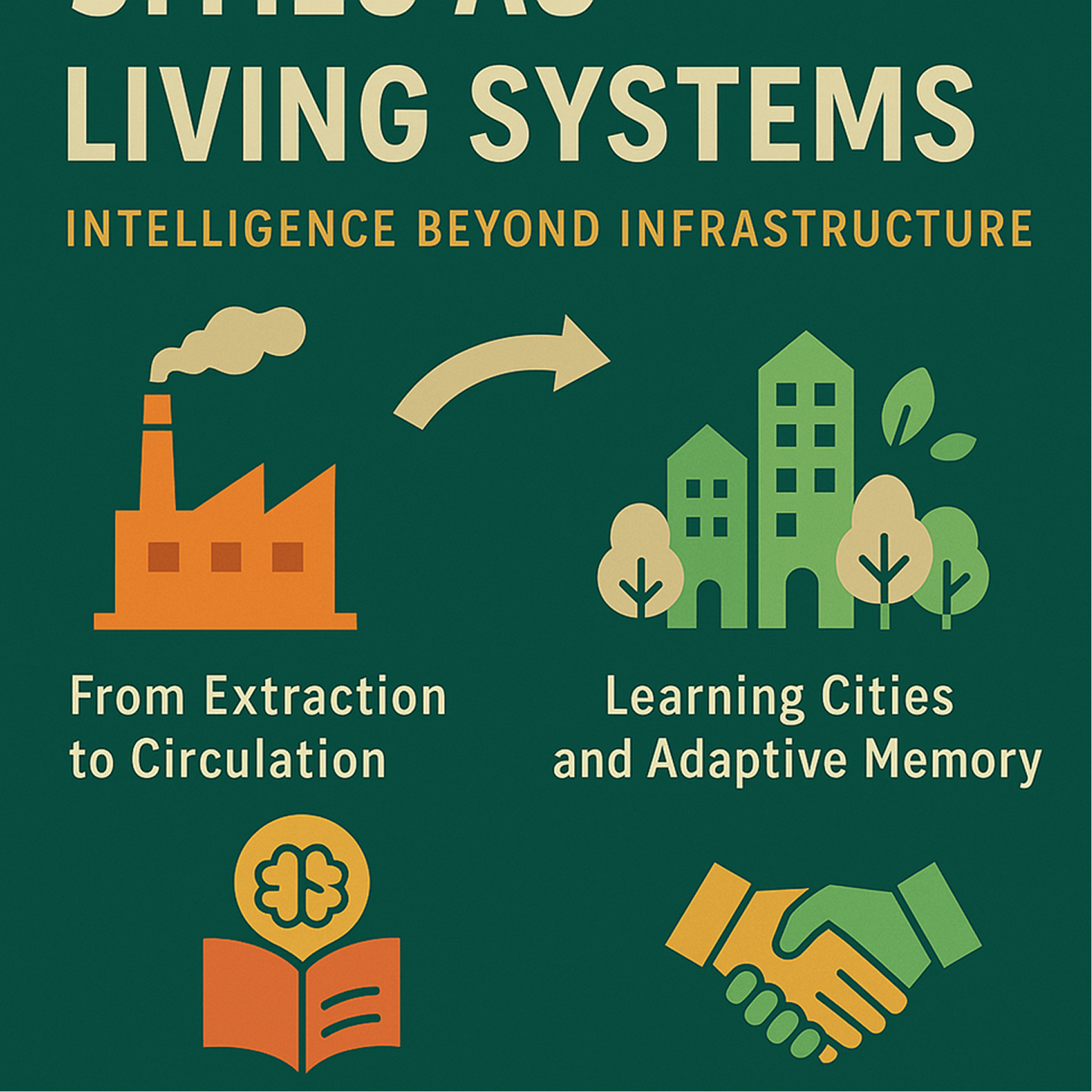
For centuries, cities were imagined as machines—assemblies of roads, grids, and pipes designed for predictable efficiency. The industrial metaphor was irresistible: the city as an engine, its citizens as moving parts, its governance as command and control. But machines do not evolve; they degrade. Living systems, by contrast, regenerate. They adapt, remember, and renew.
The Veridian Urban Index (VUI) the evolution of the earlier Veridian Urban Index—begins from this biological truth. It reads a city not through the cold lens of performance metrics but through the warmer logic of metabolism: input, transformation, release, renewal. Streets are seen as arteries, parks as lungs, institutions as immune systems, and citizens as the neural networks of collective intelligence. The question is no longer how efficiently a city functions, but how coherently it lives.
Traditional urban development has been extractive: it mines land, consumes energy, and isolates data. Regenerative cities circulate resources, knowledge, and trust. They convert waste into value, data into foresight, and diversity into resilience. The VUI decodes these circulatory dynamics through interdependent pillars—governance, ecology, memory, and economy—treating them as the organs of an integrated organism.
When one organ weakens, others overcompensate until exhaustion. A breakdown in public trust, for instance, cannot be solved by new transit lines or broadband expansion alone. It demands the regeneration of civic ethics. Similarly, no amount of green architecture can offset the decay of social cohesion. Vitality, in this sense, is systemic balance—when governance, ecology, infrastructure, and culture align to sustain life across time and scale.
A living city must also be a learning city. Algorithms in the VUI are designed not just to compute but to remember. They trace patterns of adaptation: how a city recovered from crisis, how it managed scarcity, how it preserved community during displacement. In this learning architecture, every policy, protest, flood, or festival becomes data—part of the city’s evolving DNA.
Through this continuous feedback, urban intelligence ceases to be retrospective. It becomes anticipatory. When AI learns from civic behavior rather than bureaucratic reports, it starts revealing subtle indicators of urban health: trust volatility, emotional climate, cultural confidence. The city, in turn, learns from itself.
Living systems are not governed; they are stewarded. This subtle distinction defines the ethos of the VUI. Governance enforces; stewardship restores. It listens, calibrates, and cares. A city is not a machine to be optimized—it is a commons to be cultivated. The mayor of the future will not merely manage traffic or budgets but nurture coherence across the city’s living systems: air, trust, biodiversity, and belonging.
The VUI thus becomes both compass and conscience. It tells leaders not only how their cities are performing, but what kind of life those cities are creating.
Regeneration is not about infinite growth; it is about infinite renewal. The VUI’s intelligence model redefines what progress means—less as accumulation, more as restoration. A regenerative city is one where innovation heals rather than harms, and where policy, technology, and memory operate in synchrony with ecological time.
Cities that understand themselves as living systems do not simply survive—they evolve. They metabolize crisis into wisdom, inequality into cooperation, and fragmentation into unity. In that sense, Veridian’s mission is not to build smarter cities, but wiser civilizations.