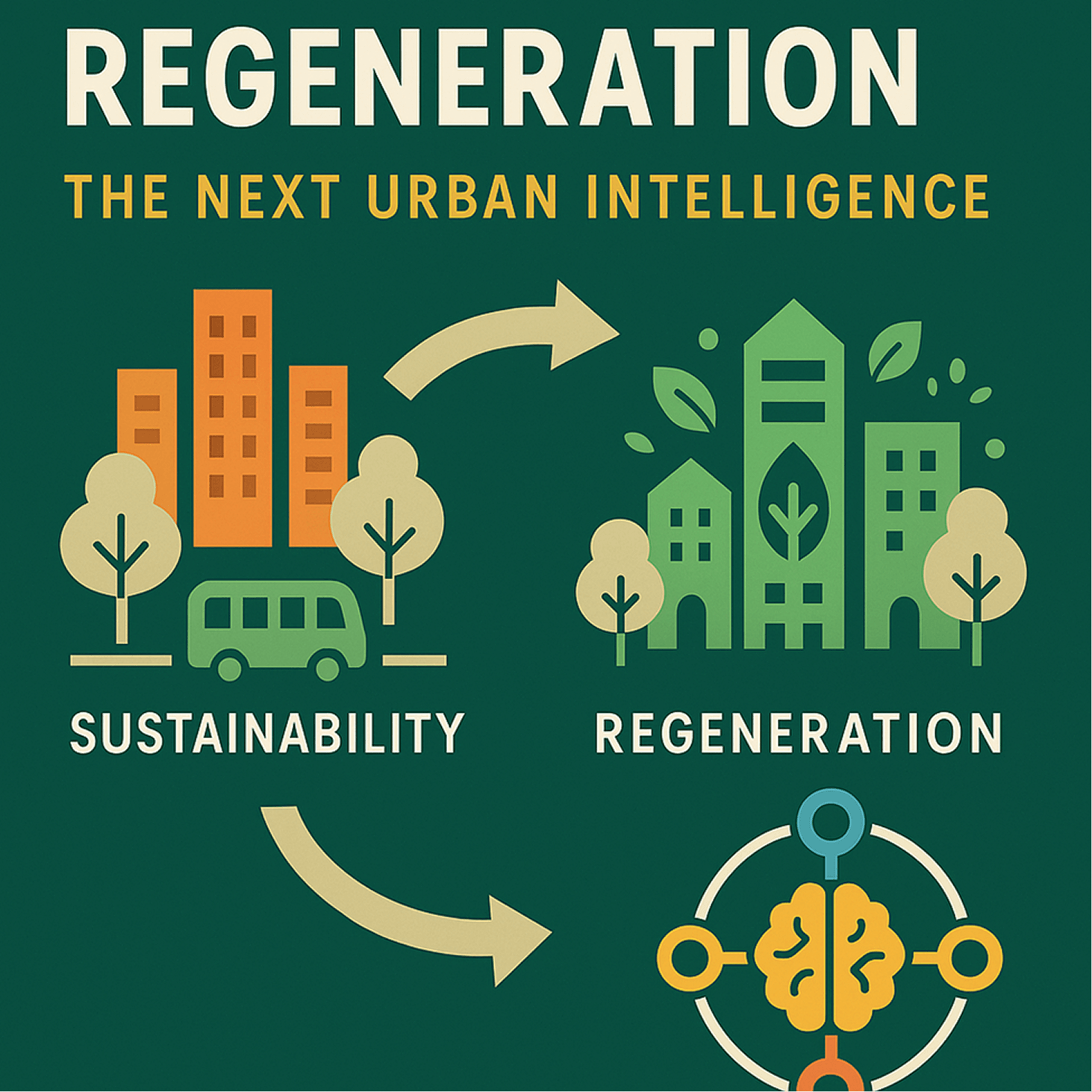
Cities have spent the last three decades chasing the mirage of sustainability—building cleaner transport, planting more trees, and reducing emissions—all while operating within the same extractive logic that made them fragile in the first place. “Sustainable” once meant doing less harm; today it must mean creating more life. Regeneration begins where sustainability ends. It’s not about preserving a system—it’s about renewing it.
Veridian Urban Systems (VUS) enters precisely at that frontier. Conceived as an AI-powered global intelligence platform, Veridian doesn’t measure cities as static entities with fixed indicators. It interprets them as living systems—dynamic organisms that breathe, metabolize, and adapt. Its 14-pillar Veridian Urban Index (VUI) is not a scoreboard; it is an interpretive compass. It fuses satellite imagery, citizen input, and institutional data into an evolving narrative of how cities heal, adapt, and sustain coherence.
The difference between sustainability and regeneration is the difference between restraint and renewal. A sustainable city asks, How can we reduce damage? A regenerative one asks, How can we restore balance and vitality? The latter shifts from linear planning to cyclical intelligence—where feedback, adaptation, and ethical learning form the city’s nervous system. Veridian’s algorithms learn not from abstractions but from the texture of real urban life: the trust between neighborhoods, the ecological rhythm of rivers, the memory embedded in architecture, and the energy coursing through digital grids.
Regeneration also redefines intelligence. Artificial intelligence, in Veridian’s design, becomes ethical intelligence—a cognitive ally that translates complexity into clarity without reducing meaning. It learns not to control cities but to serve them, revealing leverage points for systemic renewal. It allows planners to see not just where the city is efficient but where it is alive—where social cohesion, ecological repair, and institutional integrity converge to create resilience that can endure shock, reform, and rebirth.
To regenerate a city is to reconcile progress with remembrance, infrastructure with identity, and data with dignity. It means designing systems that replenish the commons—air, water, trust, and belonging. As Veridian’s platform demonstrates, the future of cities will not be decided by how “smart” they become, but by how self-renewing they can be. Regeneration is not the antithesis of growth; it is its higher form—growth that gives back more than it consumes, governance that listens before it acts, intelligence that restores rather than replaces.
Cities do not need more dashboards—they need mirrors that reflect life. Veridian Urban Systems offers exactly that: a regenerative intelligence for an urban century that must learn to heal itself.